Tuesday, November 22, 2011

Good Cop, Bad Cop


There's been a lot of police abuse lately with the OWS protests over the US. I'm watching these videos of cops going off on empty-handed protesters. And I find myself feeling both mad and vulnerable.

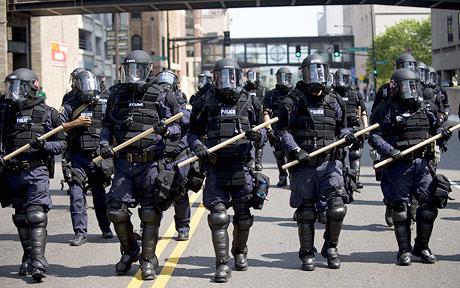
Why do police behave like this? Maybe it's the megaman-like riot gear that's turning them sour.

. 

Or it could also be the police acting as a group causing deindividuation. There's a tendency for people to behave outside peaceful social norms when they aren't individually identifiable. This seems like another good reason to enforce officers wearing their name tags. Officers sometimes forget their name plates when handling protests.

We've really created a perfect storm for misconduct. We have deindividuation, authority roles reminiscent of the Stanford Prison Experiment, and pressure to blindly follow orders like in the Milgrim Experiment. It's no wonder so many police become violently antisocial. Maybe we shouldn't be getting pissed at individual, callous officers. Instead, perhaps it's appropriate to evaluate police environment. If we can change their environment, perhaps then we can change their group behavior.

And this isn't impossible to do. Here are just a few ideas:

  • Make name plates clear. Put officer names and badge number on the back of their uniforms like a jersey.
  • Make laws that unambiguously allow citizens to record police when they're on duty. Police must not tell citizens that they cannot film.
  • Require officers to wear cameras (not just the kind used to monitor protesters). Some cities have already experimented with this. This helps protect good officers from frivolous claims as well.
  • Stop having officers dress like armored ninjas.
  • Maybe don't use wartime weapons like sound canons and tanks. Scaring everyone around you can't help.
  • Sometimes an individual or a few protesters can spoil the bunch and behave poorly. This does not authorize permission to launch an attack on entire crowds of people.
  • Save tasers, pepperspray, tear gas, flash bangs, fists, and batons for actual violent encounters. Even if police insist on arresting people illegally, they can at least do so without hurting them.
  • Many people are looking for work and are quite capable. Fire bad cops.
Not sure what I mean about police violence against protesters? Take a look:
  • (Video) A veteran was shot in the head with a tear gas canister. Then, when others came to his aid, an officer threw a flashbang grenade at them.
  • (Video) Another veteran is marched down by a line of officers in riot gear. One officer leaves the pack and beats the man down with his baton until his spleen ruptures.
  • (Video) Sitting protesters at UC Davis are peppersprayed at point-blank range.
  • (Video) Octogenarian professors are not off limits.
  • (Video) Some "nudging" with batons as described by the Associated Press.
Now this is not to say there aren't good cops out there. There are:
  • (Video) Cop checks on dressed-up protesters.
  • (Video) Cop looks out for protesters' welfare.
  • (Video) Police arresting an unruly jackass without beating him
  • (Video) This isn't in the US, but look at how the police interact with the suspect. They threaten him with tasers, but they don't use them because they're not quite necessary. They use as much physical force as they need, no more. This happens to include legitimately wrestling the suspect to the ground. Also note how stupid this suspect is. Had he followed the advice at the end of this post, he would be a lot better off.
Unfortunately, some good officers are also retaliated against by fellow officers.

Regardless if the cop you're interacting with is good or bad,  here's some decent advice (I'm not your lawyer):
  1. Don't be an asshole. Really, don't be a fucking asshole.
  2. Be polite, if you can handle that.
  3. Don't resist arrest, and don't EVER touch a cop.
  4. If a cop says he's trying to do you a favor by searching you or asking you to confess to something, then remember that cops can lie to you all day long.
  5. Say, "I'm not resisting, but I don't consent to searches."
  6. Don't offer information that can be used against you. And if you can't tell the truth, then don't say anything.
  7. If you are being arrested, announce (yes, verbally) that you are using your right to remain silent and that you want a lawyer.
  8. If you are unsure if you can go or if you don't think the officer has a right to keep you, then ask if you are free to go.

Sunday, July 3, 2011

Donate to WikiLeaks with Bitcoins. Tell MasterCard, Visa, and PayPal to Screw Themselves.


Updates (Friday, July 8):

1.
Some people may not be comfortable with using MtGox to trade bitcoins. There are two other alternatives:
Both of these sites still allow transfers from Dwolla.


2.
As of Thursday, June 7, 2011 there is an opening to donate to WikiLeaks through credit card via DataCell. WikiLeaks announced this on their FaceBook Page and Twitter. It is unclear how long this option will stay open. Visa has already taken steps to shut this door, though there are reports that Visa continues to accept the transfers anyway. The announcement was made on DataCell's website here.

But even without Visa, DataCell is still accepting donations using MasterCard and American Express here. For how long? Who knows? There is a currency transfer from Euros, but the donations go through. MasterCard, as of this writing, has not responded. Note that MasterCard previously denied WikiLeaks transfers. American Express has never had the opportunity to reject WikiLeaks donations. It will be interesting to see how American Express responds.


WikiLeaks explains the banking blockaid and their legal action against it here.
Go here to try to donate via credit card to WikiLeaks. If that doesn't work, there's always bitcoin (see original article and instructions below).


Updates (Tuesday, October 25):


Another way to support Wikileaks is to use the website "Flattr." This site has you store funds there, and then use those stored funds to donate to charities or wherever makes a "Flattr" button available to click. Wikileaks, has such a button.

So, here's how you do it:

1. Go to Flattr and set up an account.
2. Add funds via however (accepts PayPal and credit card as well). You're limited to donate 50 Euros per month. That's more than $50 for our inflated US currency, but it automatically does the exchange rate.
3. Go to Wikileaks' donate page here: http://shop.wikileaks.org/donate
4. Click on the "Flattr" icon.
5. This pops out text that includes a green donate button. Click on that.
6. Enter the amount you want to donate. You may have to use a penny under the given range and use a comma rather than period to separate dollars from cents.

And that should do it.
-------------------------------------------------------------------------------------------------------
I think we know why we're here.


 So what do  we do about these companies?

Screw MasterCard,Visa, and Paypal

Who would have guessed that a site dedicated to whistleblowing would piss off the largest corporations in the world? You? Well, okay. Good guessing.

So what do you do when these corporations control the way you donate money to Wikileaks? Apparently, you bypass these jackasses and use Bitcoin. WikiLeaks suggests it. You could also write a check and cross your fingers that it actually gets to WikiLeaks. Don’t want to write a check? Okay, keep reading for info on the bitcoin.

What’s a Bitcoin?


"What the fuck is a bitcoin," you ask? Well, after you calm down your language, I’ll tell you.
A bitcoin is a file that is recorded on a public ledger so that it is identifiable and not counterfeited. It has value because it is limited in supply; people perceive that it has value; and, importantly, people trade it for value. People also had to do work to get these coins. A person created a supply of bitcoins that he allowed to be “mined”. These coins are mined by average computer Joes that use mainly their graphics cards to solve complex problems. Over time, the problems they solve have steadily gotten harder. This helps with inflation and the predictability of bitcoin supply.

None of that makes sense? Okay, here’s a video:


What’s that? Bitcoins remind you of pogs, and you think they’ll crash? That actually doesn’t matter for your purposes. You just want to donate to WikiLeaks, right? Then you don’t need to hold on to your bitcoins. Just get them and donate them, so you don’t take on any real risk. If you want to keep some for later, then that’s up to you. WikiLeaks will thank you either way for the currency and continue doing their hard work.

How to Get Some Bitcoin to WikiLeaks.


Here’s how this is gonna happen:
  1. Set up Dwolla account and deposit funds. (there’s some waiting and confirmation stuff here)
  2. Set up MtGox account and transfer funds from Dwolla account. 
  3. Use MtGox account to buy some bitcoins.
  4. Transfer bitcoins from MtGox account to WikiLeaks, or transfer to online wallet and donate from there.
Off we go.

1.    1. Set up Dwolla account deposit funds. (US only; Otherwise, see next step)


Good job. Now sign up for an account. Don’t forget that you’re dealing with real money, so you’ll want to avoid that 12345 password. You’re going to need an account to transfer money from. It’ll ask you to confirm two deposits in your bank account as well as confirm your e-mail. You’re getting your routing and account number mixed up? Okay, here:

After you confirm the deposits, you’ll need to get money into your Dwolla account. There’s that transfer time . . . such a pain, I know. Just think of how much WikiLeaks has done for you. You can bookmark this page and continue when you get the confirmations. Also, you’ll need to transfer enough to purchase at least one bitcoin. The going rate can be found at: https://mtgox.com/, which hangs between 15-20 US dollars.

2.     2.   Set up MtGox account and transfer funds from Dwolla account.

You’ve hung in there. Good work. Go to the Bitcoin exchange market: https://mtgox.com/
Now set up an account with that clever alphanumeric password.
Click on “add funds”. It’s on the left side of the page. You have a bunch of options. If you’re from another country, use one of these:
  • Redeem MtGox code
  • Liberty Reserve
  • Cash or Check
  • Euro Bank Transfer (Europe)
  • Australian AUD Deposit (AU)
  • International USD Wire
You’re on your own there if you're not using a Dwolla account.

For those in the US that used the Dwolla account, click on that radio button and click the hyperlinked number following “account number”.

This takes you to your Dwolla Account.

You’ll see steps numbered in blue circles. The first text box will have your MtGox account number in it: MTGOX#12345X. The default is to send money from your Dwolla account to this account, so you’re good. Step 2 is to check how much you want to transfer. That’s your call. Go ahead and complete your transfer.

3.      3.  Use MtGox account to buy some bitcoins.

You’re ready to get some coins.  Click on “trade” in the left of the MtGox site. You’re asked for the number of bitcoins you want. You have to figure this out by looking at the going rate.
Look at what bitcoins are going for in the row showing the lowest asking price. Round up to the nearest cent. Divide the amount you want to spend by this going rate. That’s the amount you’re buying.

Now take the going rate number and put it in as your asking price. Note that your transaction wait will be shorter if you offer to pay a few cents higher than the lowest asking price. You can wait around if you want to save some pennies, or you can offer a few cents higher. You won’t necessarily pay the amount you offer. It’s just the max you’ll pay.

Click “Buy Bitcoins”.

You’ll see your dollar balance get lower and bitcoins get higher at the top right of your screen as the trades go through.

4.      4.  Transfer bitcoins from your MtGox account to WikiLeaks, or transfer to an online wallet and donate from there.

You’ve got your bitcoins. Kickass. Time to spend them. You can (A) make your transfer to WikiLeaks now, or (B) you can hold your money in an online wallet and transfer it from there.

A.
Click on “Withdraw Funds”. Click on the number of bitcoins you want to donate. The number must be one or greater. Keep that in mind to avoid stranding $10 or so left in the account. Now put in WikiLeaks’ bitcoin address in the box: 1HB5XMLmzFVj8ALj6mfBsbifRoD4miY36v. (Bitcoin address link goes to WikiLeaks’ page showing its number)

WikiLeaks says thanks.

If you click on account history, then you can see the withdraw transaction, though it doesn’t say the destination. 

B.
Okay, so you want to keep some leftover coin. The easiest option is to set up a virtual wallet. Go to https://www.mybitcoin.com/

Click on sign up, use your good password, and open your account. You have your own bitcoin address now to receive and transfer bitcoins.

Now go back to https://mtgox.com/. Click on “Withdraw Funds”. Click on the number of bitcoins you want to transfer to your online wallet. The number must be one or greater, and you might as well transfer it all if you’ve chosen this step. Now put in your bitcoin address from https://www.mybitcoin.com/ in the box. Transfer it on over.

Now you’re dealing with your coin at https://www.mybitcoin.com/. Click on “Send Payment”. Select however many bitcoins you want to give to WikiLeaks and insert their bitcoin address the box: 1HB5XMLmzFVj8ALj6mfBsbifRoD4miY36v. (Bitcoin address link goes to WikiLeaks’ page showing its number)

WikiLeaks says thanks. You can click on “view history” to see the exchange.

Way to be persistent! You must really like WikiLeaks. Good for you. And if you're wondering how else you can store/spend any leftover bitcoin, you may start your search here: http://www.weusecoins.com/getting-started.php.


Updates (Friday, July 8):

1.
Some people may not be comfortable with using MtGox to trade bitcoins. There are two other alternatives:
Both of these sites still allow transfers from Dwolla.

2.
As of Thursday, June 7, 2011 there is an opening to donate to WikiLeaks through credit card via DataCell. It is unclear how long this opening will stay open. Visa has already taken steps to shut this door. The announcement was made on DataCell's website here.

But even without Visa, DataCell is still accepting donations using MasterCard and American Express here. There is a currency transfer from Euros, but the donations go through. MasterCard, as of this writing, has not responded. Note that MasterCard previously denied WikiLeaks transfers. American Express has never had the opportunity to reject WikiLeaks donations. It will be interesting to see how American Express responds.

WikiLeaks explains the banking blockaid and their legal action against it here.
Sunday, June 19, 2011

Publically Available Legal Resources

I compiled this as a protest to LexisNexis and Westlaw. I hope this allows others to better navigate the legal and scholarly resources that are publicly available.


US Case and Codified Law
GoogleLegalSearch(Shows Referenced Cases)  
Justia    
PLOL(Free Registration Required)           
LII(Read the Law Heading)
Search.USA.gov(Easy Search Function for Codified Law)

Legislative History
LibraryOfCongress/Thomas        

Administrative Law

Executive Branch Agencies and Independent Agencies

US Supreme Court Oral Arguments

Local Ordinances
MiniCode           

Court Rules, Legal Forms, and Dockets

Federal Court Information
Justia    

State and Local Government General Information
State&LocalGov            

General Statistical Information

Legal Encyclopedias
Citizen’sMediaLaw         
Wikipedia/GoogleSearch(May lead to other primary and secondary sources available at your library)

Jury Instructions/Verdict Information
Georgetown (Starting at "1. Model Civil Jury Instructions by Federal Circuit")

Briefs

Trial Advocacy

Legal Dictionary

Free Physical Resources
Call your local public university library, law library, or city library. They typically have immense resources (Ex//ScienceDirect, Elsevier, Annotated References), especially if you live in an urban area.

Paid
LexisNexis and Westlaw are available for outrageously high prices from $15-$75 per minute.
You can find other paid resources ($15-$200/month) that don’t offer much more than what you can get for free. Ex// TheLaw.net, Fastcase, Loislaw, National Law Library, Versus Law, and CaseClark

Friday, April 8, 2011

Response to Greenwald: Putting the Potency back in the Partisan Voter

Glenn Greenwald recently did a piece on the impotence of the partisan voter--specifically those voting Democrat. And he was right. Democrats take the votes from the Left for granted. Democrats can violate civil liberties, pay out corporate welfare, and spend unconscionable amounts on war. Their base isn't going anywhere. At worst, some of the base will stay home instead of vote. The best Democrats have to offer is to make Republicans look worse. And even then, it's the Republicans that do most of the work.

Greenwald didn't see any answers from colleagues either. Rachael Maddow and Joan Walsh's best ideas were to give tough love for Obama only until the election year started. Then they recommend a level of unconditional positive regard that even Carl Rogers couldn't strive to.

But there is a tool to remove the eat-shit-and-smile approach of the Left's base. It's called Approval Voting. Approval Voting is a lot like Plurality--the system we're accustomed to. The only difference is that instead of being limited to one vote, you can vote for as many as you wish. But that's a bigger deal than it may sound on the surface.

Let's look at the dynamics of the political situation first. That will help us understand the problems we're dealing with. Imagine yourself as a leftie back in 2000. The candidates Gore, Bush, and Nader are important to you. You crap yourself thinking of Bush getting elected (and indeed you will). And Gore is not exactly your knight in shinning armor. He doesn't support gay marriage, he's for the death penalty, for the war on drugs, supports cap and trade rather than a carbon tax, supported NAFTA, against single-payer, and he supported strikes on Iraq.  Nader, on the other hand, is your wet dream on policy issues.

And so you have your quadrennial dilemma. You can be a frustrated pragmatist and vote for Gore; or, you can keep your integrity by voting for Nader. Of course, a Nader vote risks that you crap your pants with Bush.


But the picture is worse than this. The Left wouldn't think of describing Gore's drawbacks, just as they've been hesitant to call out Obama on his weaknesses when he ran. Instead, the Left makes excuses for the Democrat candidate. The Left becomes a collection of apologists. It even tells its political teammates to shut up on the Democrat's flaws. Indeed, this can continue even when the Democratic candidate gets elected. There is some loose tolerance mid-season, but it's back to a strict no-criticism policy once election time returns.


And yet, the picture is still worse. The Left is so afraid of Republicans that it will actually marginalize the candidates it agrees with most. The picture above is tame compared to the treatment the Left gives Nader. And when the Left marginalizes its more appealing candidates, it also marginalizes the ideas those candidates bring. Those ideas become easier to attack because they're only supported by "fringe" candidates. Single-payer health care and opposition to wars immediately come to mind. The polls of actual support for those policies aren't typically raised at this point. Besides, the Left doesn't want the Democrat to appear weak for not supporting those policies.

All this also translates into weak polling results. And the Commission on Presidential Debates requires an average of 15% over five national polls in order to participate in the debates. The political dynamic makes polling at this level a virtual impossibility. This is why you only see the Republican and Democrat in the debates. [perfect book on the debates here]

So how does Plurality Voting create all this mess? Voting consists of two parts: the expression and the calculation. The calculation part is easy--just add 'em up. No issue there. The problem is with the expression. Plurality only lets you express the minimum amount possible. Your say is limited to one candidate, and you don't get to say how much you like that candidate. And that limit to one candidate is why third-party candidates appear as fringe. Plurality prohibits voters from saying anything about the other candidates. In reality, however, the number of voters that actually support those alternate candidates is significantly greater. And it's the voters that do support those third-party candidates that wind up splitting the vote. It's here that we get our spoiler problems.


Approval Voting offers to change the current political dynamic substantially. The calculation in Approval Voting is exactly the same as Plurality. The only difference is the voter's directions. It's as simple as the depiction above. If anything, Approval Voting is easier than Plurality because Approval voters are less likely to spoil their ballot. That makes sense because voters must make their Approval ballot unreadable in order to spoil it. And this is no problem for voting machines either--not that this is an endorsement of voting machines. The point is that Approval Voting is easy, maybe even easier than Plurality.

Because Approval Voting lets voters choose more than one candidate, this eliminates vote splitting and thus the spoiler effect. So you like Nader but still don't want Bush to win? Then use your Approval vote for both Nader and Gore. They each get one vote added to their tally. And you won't want to abandon voting for Gore until it's clear that either Bush isn't in the running or Gore himself is no longer competitive. You can think of it as voting like you would under Plurality given the polls, but then you continue as you wish. The good part is that Approval Voting always lets you vote for your favorite. [more on strategy here]

So that's nice. Approval Voting eliminates spoilers. But what does Approval Voting do for the potency of the partisan voter? The reason voters on the Left have no power is because Democrats don't have to listen to their policy concerns. But Approval Voting allows those policy concerns to gain ground. Approval Voting legitimizes those policies of the Left by giving third-party candidates a more accurate level of support. Indeed, large-scale French studies contrasting voting systems show significantly more support for third-party candidates when Approval Voting is used. This result has been consistently repeated.

So no more of that 1-2% of the vote nonsense for legitimate third parties and independents. It's also difficult to marginalize third-party candidates when they're polling over 30% or 40%. Under Approval Voting, a Democrat that ignores third-party issues now risks losing the race. Approval Voting has it so that even when the Democrat does win, the Left still gets what it wants. That's because the Democrat can't ignore the Left's issues anymore. At the very least, those issues will have to be included in the political dialogue. And higher poll numbers for third-party candidates will make it nearly impossible to exclude the candidates from debates. This legitimization of ideas and candidates is the power Approval Voting gives the partisan voter. And the Left should be clamoring for it.

[Technical notes:
  • Instant Runoff Voting (IRV) won't solve your problems. True, IRV does mitigate vote splitting with fringe spoilers. But it fails when candidates become competitive. IRV splits the votes of popular centrist candidates. The popular centrist has its votes split by competitors from either side of the political spectrum. This vote splitting occurs because there is only one first-choice vote. The popular centrist candidate then gets eliminated by having the least first choice votes. Visual here.
  • Also, IRV is a nonmonotic system. This means scenarios arise when you can hurt your candidate by voting for them and help them by voting against them. Specifically, this craziness happens about 15% of the time with IRV elections. This rate doubles to about 30% when IRV picks a winner other than the Plurality winner. Also, IRV doesn't let you vote your favorite, as was seen in the Burlington, VT election.
  • Approval Voting does not regress to Plurality through bullet voting.]

Tuesday, February 1, 2011

New Hampshire Introduces Bill to Bring Approval Voting State Wide

The following is taken directly from The Center for Election Science.

New Hampshire House Bill 240

In January of 2011, New Hampshire state representative Dan McGuire created HB 240. HB 240 would establish Approval Voting for all state offices and presidential primaries. The bill enables approval voting by removing the restriction to choose only one candidate. Voters would be able to vote for all the candidates they liked, not just one.

Approval Voting highlights:
  • More expressive
  • No vote splitting or spoilers, ever
  • Always vote your honest favorite
  • Significantly less spoiled ballots
  • Results are easy to understand, just like Plurality
  • Ballots are familiar to voters and look essentially the same as Plurality
  • Alternate candidates get a more accurate measure of support
Approval Voting at any level, especially statewide, would significantly improve democracy over Plurality. Here is a brief FAQ on this subject:


What is Approval Voting?

Approval Voting simply means that voters can vote for as many candidates as they choose. It is traditionally applied to single-winner elections.  Approval Voting is more expressive than the typical way we vote — Plurality Voting. That's because Plurality Voting limits voter expression to only one candidate. This concept of being able to pick multiple candidates is already familiar to voters. Voters do this when electing school boards and councils. The difference is that with Approval Voting only one winner is elected.

Consider a race between candidates Jones, Smith, and Thomas. You might vote for Jones if you disliked Smith and Thomas.  But a voter with the opposite preferences might vote for Smith and Thomas.

What would the change in ballot look like for New Hampshire voters?

Really, all voters would see is a change in directions allowing them to vote for their choice "or choices." Click the ballots below to see for yourself.

How would Approval Voting results differ from Plurality Voting results?

Political scientists in France and Germany conducted two large-scale Approval Voting surveys based on their current elections. These studies reinforced the positive benefits of Approval Voting. For instance, voters using Approval Voting largely chose to vote for more than one candidate (i.e. they didn't widely bullet vote). Also, the candidates showing scant support under Plurality Voting were better represented under Approval Voting. These more accurate reflections using Approval Voting likely come from its good properties. Approval Voting is completely immune from vote splitting (no spoiler effect, ever), and it always allows voters to express their honest favorite.


How will Approval Voting affect spoiled ballots?

Without a doubt, using Approval Voting will drastically decrease the number of spoiled ballots. Technically, it's impossible to spoil an Approval ballot. If a voter approves anywhere between zero to all candidates (all combinations), then they've submitted a valid vote. To spoil an Approval ballot, a voter has to make the ballot unreadable — rather difficult. In fact, in the French and German studies referenced above, under 0.5% of voters managed to accomplish this folly (that's less than one in two hundred).

Plurality Voting ballots are treated as spoiled whenever voters mark more than one candidate. The fact that voters do this tells us that they have more to say than Plurality Voting permits. Consequently, in the 2000 U.S. elections, nearly two million ballots were spoiled — almost 2%.

Plurality Voting's spoilage rate of around one in fifty is almost four times more than Approval Voting. Had Approval Voting been used in 2000, not only would there have been no spoiler effect, but poll workers could have counted around one and a half million more voters' ballots.


Does Approval Voting help major parties or minor parties?

While this may sound impossible, we contend that Approval Voting is fairer to both major parties and minor parties. More importantly, Approval Voting is fairer to voters.

Is Approval Voting vulnerable to tactical voting?

Approval Voting is highly resistant to tactical voting. Tactical voting is when voters don't cast purely honest ballots. For a closer look on how Approval Voting is resistant to tactics, go here.

Doesn't Approval Voting violate "one person one vote"?

No. The term "one person one vote" refers to the weight of votes, not to how votes are expressed. And in Approval Voting, all ballots have the same weight. 

The U.S. Supreme Court made the "one person one vote" rule explicit in Reynolds v. Sims (377 U.S. 533). The rule stated that no vote should count more than any other so that it has unequal weight. This unequal weight would violate the Equal Protection Clause of the Constitution. And it was Baker v. Carr (369 U.S. 186) that extended the Equal Protection Clause to districting issues. In Reynolds, the state of Alabama set up its districts so that they varied wildly in population. The districting was so bad that it gave some voters' ballots as much as 41 times more weight than others. Because the weights of the ballots were different between districts, that violated the "one person one vote" rule.

Consider again the Jones-Smith-Thomas Approval Voting example where all three candidates are tied. You vote for Jones, while a voter with your exact opposite preferences votes for Smith and Thomas. After that, all three candidates are still tied. Those two ballots have an equal but opposite effect. The key here is that no voter can vote more than once for the same candidate. Another way to think about it is that every voter casts an "up" or "down" vote for every candidate.
According to The International Encyclopedia of Elections, approval voting does not violate any state constitutions in the United States. Here's a Constitution-based view of the subject, from The Center for Range Voting. (Range Voting is another name for Score Voting, and Approval Voting is just a simplified form of Score Voting where the "score" is effectively a one or a zero.)

Where can I learn more about Approval Voting?

Steve Brams, an NYU political science professor from Concord, describes Approval Voting in layperson-friendly terms here.

Warren Smith, a Princeton math Ph.D. who has researched voting issues for over a decade, gives this detailed account of Approval Voting history.

But what about Instant Runoff Voting?

Our extensive analysis over the years overwhelmingly supports the view that Approval Voting is a much simpler and more democratic system than IRV. The results of Approval Voting elections are also much easier to understand than the numerous rounds of vote transfers that IRV utilizes.  Don't take our word on it.  Click below for the Oakland 2010 IRV election results.  If that had been an Approval Voting election, you would only see approval percentages and total votes for each candidate — much simpler.


Where has Approval Voting been used?

A modified form of Approval Voting was used to elect the first four US Presidents.

In 1990, Oregon used Approval Voting in a statewide advisory referendum on school financing, which presented voters with five different options and allowed them to vote for as many as they wished. (Incidentally, in 1987, a bill to enact Approval Voting in certain statewide elections passed the Senate but not the House in North Dakota.)

Approval Voting has been used in internal elections by the political parties in some US states, such as Pennsylvania, where a presidential straw poll using Approval Voting was conducted by the Democratic State Committee in 1983.

Approval Voting is used to elect the Secretary General of the United Nations.

Approval and Score Voting were the foundation of government in renaissance Venice, and Ancient Sparta, respectively.  These were two of the longest lasting (perhaps the two longest lasting) democracies ever. Also, Cardinals used Approval Voting for centuries to elect the Catholic Pope (at the time the most powerful elected person on the planet).

In the early 2000s the Boston Tea Party became apparently the first US political party in modern times to employ Approval Voting. Approval Voting is also used by the state Libertarian Party in Colorado and Texas.

Several large organizations, with membership well in excess of the number of citizens in many US cities, use Approval Voting:
  • Mathematical Association of America (MAA), with about 32,000 members;
  • American Mathematical Society (AMS), with about 30,000 members;
  • Institute for Operations Research and Management Sciences (INFORMS), with about 12,000 members;
  • American Statistical Association (ASA), with about 15,000 members;
Smaller societies that use Approval Voting include the Society for Judgment and Decision Making, the Social Choice and Welfare Society, the International Joint Conference on Artificial Intelligence, the Pubic Choice Society, and the European Association for Logic, Language and Information.

Additionally, the Econometric Society has used Approval Voting (with certain emendations) to elect fellows since 1980; likewise, since 1981 the selection of members of the National Academy of Sciences at the final stage of balloting has been based on Approval Voting. Coupled with many colleges and universities (e.g. San Francisco State University's Academic Senate) that now use Approval Voting– from the departmental level to the school-wide level – at least several hundred thousand individuals have had direct experience with approval Voting.

If New Hampshire passes this bill, it will be the first time that traditional Approval Voting will be used to elect U.S. public officials. To imagine that it may take place throughout an entire state is truly exciting.

Tuesday, July 20, 2010

Range Versus Caveman Voting


Range voting is a single-seat voting system that never forces voters to betray their favorite, is immune to vote splitting, and is highly expressive.

This video was initially on the website RangeVote.com. The end of the video shows a link for the next part of the video. For details on range voting, see The Center for Range Voting.

For range voting in brief, see: here

Sunday, July 18, 2010

Duopoly Must Go: An Appeal for Score Voting

Matt Gonzalez has graciously used his blog to host an essay from the folks at the Center for Range Voting/Election Science Foundation. For those that aren’t familiar with Matt Gonzalez, here’s a background:

Matt was the head of the Board of Supervisors in San Fransisco as a member of the Green Party. He also ran for mayor of San Fransisco as a Green. Despite being outspent 5-1 and having the likes of Al Gore come to rally for his opponent, Matt was within 6% of the runoff winner, Gavin Newsome. Matt was also the VP running mate of presidential candidate Ralph Nader in 2008.


The following essay can be found at Matt Gonzalez's blog, As It Ought to Be:

Duopoly Must Go: An Appeal for Score Voting

by Andrew Jennings, Clay Shentrup, Warren D. Smith


Progressive thinkers on all sides of the political spectrum often wonder why the United States seems incapable of escaping a two-party political system. Is it a result of an extreme demographic situation, an urban and a rural America so large and obstinate that they are incapable of cooperation? Does it somehow come from the unique American spirit, a tradition steeped in individualism and adventure? Are the third parties being silently stifled because of their opposition to our incessant march toward rule by large corporations? The answer, in fact, may be so simple that it is right at our fingertips at least once a year. Every time we vote, in fact.

Fifty years ago, French sociologist Maurice Duverger observed that the plurality voting method tends to favor a two-party system, whereas “the double ballot majority system [a.k.a. 'top-two runoff'] and proportional representation tend to multipartism.” Observations in the social sciences are never absolute, but this tendency for plurality voting to maintain two-party domination is so reliable that it has become known as Duverger’s Law.

Plurality voting (a.k.a. “first past the post”), by far the most common system in the United States, is where each voter votes for one candidate and the candidate with the most votes wins, even if he receives fewer than 50% of the votes. Top-two runoff (a.k.a. “TTR” or “delayed runoff”) is just like plurality voting, except that if no candidate receives a majority of the votes, then a subsequent election is held between the top two finishers.
Few would expect the way we count our votes to be the primary factor determining the layout of our political landscape, but the evidence is overwhelming. Beyond the empirical trends to which Duverger referred, mathematical analysis of these voting methods suggests a causal relationship. For instance, a plurality voter who prefers a Green Party candidate will often take the tactical route, casting an insincere vote for the Democrat in order to prevent the Republican from winning. This costs the voter very little, since a minor party candidate is by definition unlikely to win anyway. It seems clear that such tactics keep us locked in a two-party system.

A top-two runoff system differs considerably. To echo Duverger, most of the approximately 30 countries which use this system have escaped two-party domination, even in single-seat non-proportional elections. And as with plurality voting, analysis of the runoff system strongly suggests that this is not a coincidence, but in fact a result of voter psychology and the different tactical incentives at play. For instance, voters in the runoff have no incentive to cast an insincere vote, as there are only two choices. And once the options are narrowed down to two candidates, voters often have a better chance to get to know an otherwise unknown challenger. These factors may largely explain how Green Party candidate Matt Gonzalez was able to come within striking distance of Democrat Gavin Newsom for mayor of San Francisco in 2003 (the margin was less than 6%) despite being outspent five to one, and despite Newsom’s being endorsed by a host of powerful beltway politicians.

Opinions vary as to the relative merits of TTR versus other systems, and the above is not meant as an endorsement of TTR per se. Rather, it is a testament to the extent to which the voting method determines the party composition of a government. It seems clear that if we want to escape the two-party stranglehold, we must adopt a different voting method; specifically one which is not known to also maintain two-party domination.

Many of the modern efforts for voting reform promote an alternative form of runoff, called instant runoff voting (“IRV”), which allows voters to rank the candidates and appears to offer us a way out of our electoral difficulties. Unfortunately, communities and scholars are discovering that the hope IRV offers us for escaping our two-party system is only illusory.

Like TTR, IRV doesn’t fix the spoiler problem: a bloc of voters may get a worse result by supporting their sincere favorite candidate. For instance, in the 2009 mayoral election in Burlington, Vermont, a group of voters who preferred Republican over Democrat over Progressive could have gotten the Democrat instead of the Progressive by insincerely top-ranking the Democrat instead of the Republican. It may seem strange to think of the GOP candidate as the spoiler, but the ballot data shows that a majority of voters in left-leaning Burlington would have taken the Progressive or the Democrat over the Republican in a runoff election, making the GOP more akin to a third party in this particular circumstance — albeit a strong third party.
And therein lies the rub. See, most voters picture runoffs in the context of weak third parties. The thinking goes that if you prefer, say, Green over Democrat over Republican, then you can safely support the Green. If the Green doesn’t make it to the runoff, then your support will simply go to the Democrat. But that is only the first phase of a third party’s growth. Next imagine that the Green Party, freed from the fear of “wasted votes,” grows to encompass more and more of the electorate until it can outlast the Democrats and make it to the runoff. Finally, imagine a third phase in which the Greens have grown enough to not only defeat the Democrats, but to win against the Republicans in the runoff. This third phase represents the greatest hopes for those who see IRV as a way to end the stifling two-party stranglehold on government.

But this rosy picture starts to darken the moment we take account of two crucial factors. First, it must be noted that each of these three phases is generally a prerequisite for the next. This is explained concisely as follows: as a third party grows, it will become powerful enough to defeat its most similar major party before it will become powerful enough to defeat both major parties. Second, the middle phase is effectively a barrier to the third. It is precisely the scenario experienced in Burlington. In this phase, the Greens defeat their most similar opponent, only to lose in the runoff. For Greens who prefer the Democrat to the Republican, the announced ballot totals will make clear to them that their honesty caused them to get the Republican instead of the Democrat. If even a mere 10% of them decide to cast a tactical vote for the Democrat in the next election, then even a prodigious 10% increase in their popularity by that time will be completely nullified. More realistically, their popularity would increase by less than 10%, in which case the tactical behavior would bring them down faster than they could increase their membership.

Many IRV proponents have argued that such strategy is infeasible and/or inadvisable, since it is likely to “backfire.” We address this theoretical argument in detail elsewhere, but for now let’s put aside contentious theorizing, and turn our attention to empirical reality. Australia uses instant runoff voting to fill each of the 150 seats in its House (has used IRV since 1918). It also uses other methods for other elections, e.g. its Senate is elected with a multiwinner method called PR-STV (proportional single-transferable vote). Australia’s House is two-party dominated; in the elections of 2001, 2004, and 2007 combined, not a single house seat was won by a third-party member. In contrast, quite a few seats in their Senate (e.g. 9 out of 76 in their 2005-2008 Senate and 6 in the 2008-2011 Senate) were/are occupied by third parties, mainly the Greens.

The same trend has been observed with IRV elsewhere, such as the Irish presidency (a near monopoly despite being mostly ceremonial), and in Malta and Fiji (before it was a dictatorship). And it is interesting that San Francisco supervisor Ross Mirkarimi (who helped found the California Green Party) switched from Green to Democrat in early 2010, despite the fact San Francisco now uses IRV, instead of the delayed runoff system it used when Matt Gonzalez made his impressive mayoral bid.

Of all these examples, Australia may be the most pertinent. We noted that their Senate uses STV, while their House uses IRV. STV is a multiwinner proportional system, and it so happens that IRV is actually the single-winner form of STV, so both systems use the same ranked ballot. Thus it is not too surprising that many American election activists see the adoption of IRV as a crucial “stepping stone” to proportional representation via the adoption of STV. IRV gets voters accustomed to ranking the candidates, and puts the basic machinery in place to tabulate those ranked ballots in the specific manner that STV entails. Even IRV proponents who are aware of its tendency for duopoly often support it for this very reason; they want proportional representation. In fact FairVote, the organization most often associated with the push for IRV, was founded in 1992 as “Citizens for Proportional Representation” (and later the “Center for Voting and Democracy”), and it seems that behind the scenes, their pursuit of IRV is a long-term play for proportional representation in America.

The stepping stone strategy might actually make sense were it not for the USA’s rigid impediments to proportional representation, which was made illegal at the federal level via a 1967 law which outlawed multi-member districts. In 1996, congresswoman Cynthia McKinney (who later ran as the Green Party candidate for US President) wrote, but failed to pass, bill HR 2545, which would have overridden that previous 1967 law. She re-introduced a similar bill, HR 1189, in 2001. It failed again. Then she tried again with HR 2690 in 2005. It failed yet again.

This leads us to believe that PR will be federally unobtainable in the USA as long as we are two-party dominated (a Congress dominated by two parties will continue to block anti-duopoly legislation such as McKinney’s). We therefore believe that proponents of PR must find a single-winner voting method which doesn’t maintain duopoly, as a prerequisite to PR. As has been noted, ordinary top-two runoffs fit that description, but they have their own problems, both in terms of voter turnout and the cost and fatigue associated with extra elections. And they can still leave voters justifiably fearful of supporting candidates they sincerely prefer to the apparent frontrunners, in the first round. (As a reminder, voters have no incentive to be insincere in the runoff.)

There are other voting systems that work with a ranked ballot and have several advantages over instant runoff voting (e.g. Condorcet methods), but even more exciting is a simpler class of voting systems discovered in the past few decades, based on an entirely different paradigm: ratings rather than rankings. These systems let each voter consider each candidate separately and assign to each a score or grade.

In his 2008 book Gaming the Vote, author William Poundstone (an MIT physics grad) suggests a voting method called range voting (a.k.a. score voting), in which voters rate the candidates on a scale such as 0-10 or 1-5. When the scale is reduced to 0-1, we effectively have approval voting, which is identical to plurality voting except that there is no limit on the number of candidates a voter may support. A third method, the Majority Judgement, asks the voters to use a few natural-language terms (Excellent/Good/Acceptable/Unacceptable, for example) to grade the candidates and chooses the winner by finding the candidate who was given the highest grade by a majority of voters (the median grade).

Score voting has historically been overlooked, based on the assumption that it would succumb to pervasive tactical exaggeration. But that view was debunked back in 2000, when a Princeton math Ph.D. named Warren D. Smith performed an extensive set of computer calculations which showed the system working extremely well, even with high rates of tactical voting. This is based on an objective “economic” indicator of voter satisfaction with (or “representativeness of”) election outcomes, called Bayesian regret.

This can be understood if we think for a moment about a voter whose preferences are Nader=10, Gore=6, Bush=0. If this voter is sincere, he casts those very scores. But if he is a tactical voter, like those who voted for Gore instead of Nader under plurality voting, how should he vote under score voting? For starters he wants to give Gore a 10, and Bush a 0, to maintain the tactical advantage he sought under plurality voting. But he can additionally give a 10 to Nader, and any other candidates he prefers to both frontrunners, with no fear of negative consequences. (In election theory parlance, we say that score voting passes the Favorite Betrayal Criterion.) Whereas you will recall that with IRV, tactically placing the Democrat in first place absolutely requires a Green voter to place the Green lower than first place. But with score voting, giving Gore a maximum score in no way prevents a voter from still giving Nader a maximum score too. So third parties face no artificial barrier to growth, as they do with IRV.

A simple way to think of it is that a tactical score voter should support the same candidate as he would with a plurality ballot, and then also support all the candidates he likes better. This means that the appearance of being “unelectable” need not become a self-fulfilling prophecy, like with plurality, IRV, and so many other methods. If it turns out that enough voters prefer a minor party or independent candidate to the presumed frontrunners, then he can actually win, even if the voters are highly tactical! Empirical evidence strongly suggests election outcomes will then be vastly more representative of the actual relative support for the candidates.

We believe this has enormous consequences, beyond the obvious opportunity to escape from two-party domination. For instance, the inordinate importance of cash in elections is largely a product of the need to prove electability. Consider exit polling from 2000 in which 90% of Nader supporters claimed to have voted for someone other than Nader. This shows that the number of votes Nader could have received by convincing voters he could be elected (e.g. by having an enormous campaign “warchest” and/or getting the nomination of a major party) was nine times as large as the number of votes he won by trying his best to convince voters he should be elected. Also consider that in the 2008 US presidential election, Mitt Romney spent large amounts of cash from his personal fortune to bus in voters to straw polls with no legal consequence whatsoever, apparently in order to be seen early on as a frontrunner, so as not to be abandoned by tactical voters, who fear wasting their vote on candidates who can’t win.

These may seem like anecdotes, but their prevalence amounts to something greater. Money matters far too much in today’s political process. And efforts to curb that with typical campaign finance reform are inherently unstable, as cheaters will be more likely to win elections, and then just make their cheating retroactively legal, and/or intimidate government officials who dare to try to prosecute them. We believe it may be more effective to try to reduce the inherent importance of cash, than to wage a potentially futile battle to level the playing field. With score and approval voting, a candidate need not prove his electability in order to earn your vote.
In summary, we would be wise to realize that the lack of alternative choices in American politics is unlikely to be repaired without changing to a better voting system, and that instant runoff voting is probably not the answer. We should give serious consideration to voting systems based on ratings, where voters can evaluate each candidate independently, and never fear giving their full support to the candidates they prefer to the frontrunners. While it’s impossible to predict exactly how these systems will play out in practice, the theory and a great deal of empirical evidence make them seem promising, and it’s clear that the systems we have now are not working and it’s time to look outside the box for a voting system that will truly support smaller parties and encourage alternative ideas in our political discourse.

Saturday, July 3, 2010

Approval Voting Video


I'm trying out some video stuff. Feel free to let me know what you think. Approval voting as described here is for a single-winner office election. Here are some useful links:

Steven Brams on approval voting: http://bigthink.com/ideas/18726

Approval voting nonprofit: http://www.approvalvoting.org/

Video comparing voting systems: http://www.teach12.com/ttcx/VotingFre...

Voting systems in general: http://en.wikipedia.org/wiki/Single-w...

More on voting systems at The Center for Range Voting: http://rangevoting.org/

The book to read on voting systems is, of course, Gaming the Vote:
 Gaming the Vote: Why Elections Aren't Fair (and What We Can Do About It)

If you're interested in the Commission of Presidential Debates, check out No Debate:
No Debate: How the Republican and Democratic Parties Secretly Control the Presidential Debates


Monday, June 14, 2010

News Flood--Focus on Gaza Flotilla


By now we've all heard of the Israeli attack on the flotilla aid ship set for Gaza. If not, a background can be found here. This attack was carried out in international waters. The flotilla intended to violate the Israeli blockade against Gaza by providing humanitarian aid. Much of what has been presented is a sort of "debate" over self defense. But autopsy reports present a different picture. This story shows evidence of repeated close range shots to the back of the head and to the back. It is difficult to justify this as self defense. It appears Israel is also attempting to use the tactic of information control, but fortunately information is still getting out. As noted in the previous post, US tax dollars help to support the Israeli military in such raids--$2.5 billion in grants specifically for military aid in 2009 alone.

Summary of Turkish Autopsy Report


So why all the fuss over Gaza? Is the poverty really that bad? See the video above and decide for yourself.

The US has refused to call for an international investigation of the attack against the flotilla. Instead, it insists that Israel be able to conduct its own internal investigation. To investigate the US's stance, we should look at how the US has looked at this conflict in the past. So how has this conflict between Israel and Palestine traditionally been reported in the US? Here's an analysis of just that (another source):

Actual Conflict Deaths Vs. Reported in U.S. Media

(Reporting over 100% refers to repetitions in broadcasts)

Actual Children's Deaths Vs. Reported in U.S. Media

The Historical Conflict in a Nutshell
About This Topic

The Israeli-Palestinian conflict is one of the world's longest standing conflicts. Many people feel that resolving this conflict is the key to resolving the various conflicts throughout the Middle East. Some observers see this conflict creating Arab resentment towards the "West" and fueling radical Islamic terrorism. Although the conflict generates massive public discussion and debate, there are relatively few (if any) forums that inherently maintain an impartial and non-partisan approach to understanding it. We intentionally expose the massive variations of opinion, narrative and fact, to give our readers the best "big picture" understanding of the conflict and its potential solutions.
PRO Israel/CON Palestine CON Israel/PRO Palestine

The Pro-Israel camp generally base their arguments on the following principles:
a) Israel is the historical "homeland" of the Jewish peoples who have lived there continuously since biblical times.
b) Many Jews believe that they deserve a "Jewish" state because of historical injustices, such as the Holocaust, and because they have international support and recognition through the U.N.
c) The majority of Israelis support a "two-state" solution, creating a Palestinian state alongside Israel in Gaza and the West Bank.
d) Other Israelis support the idea of "one-state", either by annexing all occupied territories into the Jewish state (far right view), or incorporate the occupied territories into one secular democratic state with equal rights for all (far left view).

The Pro-Palestinian camp generally base their arguments on the following principles:
a) The Palestinian people have lived in the area of Israel/Palestine since biblical times. They see most Israeli Jews as foreign colonizers who began arriving within the last 100 years.
b) Palestinians consider themselves a national entity, deserving of the rights of all nations, including a Palestinian state.
c) Many Muslim Palestinians and their supporters see the land as Islamic holy land, and are strictly opposed to non-Muslims owning and establishing a state on Muslim land.
d) Palestinians vary widely in what they see as a just solution to the conflict. They include: the total destruction of Israel; a "bi-national" or "one-state" solution; and a "two-state" solution.
(Ref: Pro/Con.org)

Sharing Is Good

Wikio
Related Posts with Thumbnails