Showing posts with label Other Intellectual Pursuits. Show all posts

Tuesday, November 22, 2011

Good Cop, Bad Cop


There's been a lot of police abuse lately with the OWS protests over the US. I'm watching these videos of cops going off on empty-handed protesters. And I find myself feeling both mad and vulnerable.

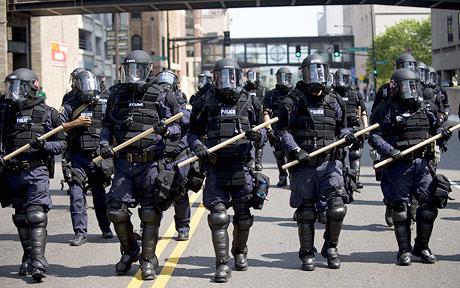
Why do police behave like this? Maybe it's the megaman-like riot gear that's turning them sour.


Or it could also be the police acting as a group causing deindividuation. There's a tendency for people to behave outside peaceful social norms when they aren't individually identifiable. This seems like another good reason to enforce officers wearing their name tags. Officers sometimes forget their name plates when handling protests.

We've really created a perfect storm for misconduct. We have deindividuation, authority roles reminiscent of the Stanford Prison Experiment, and pressure to blindly follow orders like in the Milgrim Experiment. It's no wonder so many police become violently antisocial. Maybe we shouldn't be getting pissed at individual, callous officers. Instead, perhaps it's appropriate to evaluate police environment. If we can change their environment, perhaps then we can change their group behavior.

And this isn't impossible to do. Here are just a few ideas:

  • Make name plates clear. Put officer names and badge number on the back of their uniforms like a jersey.
  • Make laws that unambiguously allow citizens to record police when they're on duty. Police must not tell citizens that they cannot film.
  • Require officers to wear cameras (not just the kind used to monitor protesters). Some cities have already experimented with this. This helps protect good officers from frivolous claims as well.
  • Stop having officers dress like armored ninjas.
  • Maybe don't use wartime weapons like sound canons and tanks. Scaring everyone around you can't help.
  • Sometimes an individual or a few protesters can spoil the bunch and behave poorly. This does not authorize permission to launch an attack on entire crowds of people.
  • Save tasers, pepperspray, tear gas, flash bangs, fists, and batons for actual violent encounters. Even if police insist on arresting people illegally, they can at least do so without hurting them.
  • Many people are looking for work and are quite capable. Fire bad cops.
Not sure what I mean about police violence against protesters? Take a look:
  • (Video) A veteran was shot in the head with a tear gas canister. Then, when others came to his aid, an officer threw a flashbang grenade at them.
  • (Video) Another veteran is marched down by a line of officers in riot gear. One officer leaves the pack and beats the man down with his baton until his spleen ruptures.
  • (Video) Sitting protesters at UC Davis are peppersprayed at point-blank range.
  • (Video) Octogenarian professors are not off limits.
  • (Video) Some "nudging" with batons as described by the Associated Press.
Now this is not to say there aren't good cops out there. There are:
  • (Video) Cop checks on dressed-up protesters.
  • (Video) Cop looks out for protesters' welfare.
  • (Video) Police arresting an unruly jackass without beating him
  • (Video) This isn't in the US, but look at how the police interact with the suspect. They threaten him with tasers, but they don't use them because they're not quite necessary. They use as much physical force as they need, no more. This happens to include legitimately wrestling the suspect to the ground. Also note how stupid this suspect is. Had he followed the advice at the end of this post, he would be a lot better off.
Unfortunately, some good officers are also retaliated against by fellow officers.

Regardless if the cop you're interacting with is good or bad,  here's some decent advice (I'm not your lawyer):
  1. Don't be an asshole. Really, don't be a fucking asshole.
  2. Be polite, if you can handle that.
  3. Don't resist arrest, and don't EVER touch a cop.
  4. If a cop says he's trying to do you a favor by searching you or asking you to confess to something, then remember that cops can lie to you all day long.
  5. Say, "I'm not resisting, but I don't consent to searches."
  6. Don't offer information that can be used against you. And if you can't tell the truth, then don't say anything.
  7. If you are being arrested, announce (yes, verbally) that you are using your right to remain silent and that you want a lawyer.
  8. If you are unsure if you can go or if you don't think the officer has a right to keep you, then ask if you are free to go.

Sunday, July 3, 2011

Donate to WikiLeaks with Bitcoins. Tell MasterCard, Visa, and PayPal to Screw Themselves.


Updates (Friday, July 8):

1.
Some people may not be comfortable with using MtGox to trade bitcoins. There are two other alternatives:
Both of these sites still allow transfers from Dwolla.


2.
As of Thursday, June 7, 2011 there is an opening to donate to WikiLeaks through credit card via DataCell. WikiLeaks announced this on their FaceBook Page and Twitter. It is unclear how long this option will stay open. Visa has already taken steps to shut this door, though there are reports that Visa continues to accept the transfers anyway. The announcement was made on DataCell's website here.

But even without Visa, DataCell is still accepting donations using MasterCard and American Express here. For how long? Who knows? There is a currency transfer from Euros, but the donations go through. MasterCard, as of this writing, has not responded. Note that MasterCard previously denied WikiLeaks transfers. American Express has never had the opportunity to reject WikiLeaks donations. It will be interesting to see how American Express responds.


WikiLeaks explains the banking blockaid and their legal action against it here.
Go here to try to donate via credit card to WikiLeaks. If that doesn't work, there's always bitcoin (see original article and instructions below).


Updates (Tuesday, October 25):


Another way to support Wikileaks is to use the website "Flattr." This site has you store funds there, and then use those stored funds to donate to charities or wherever makes a "Flattr" button available to click. Wikileaks, has such a button.

So, here's how you do it:

1. Go to Flattr and set up an account.
2. Add funds via however (accepts PayPal and credit card as well). You're limited to donate 50 Euros per month. That's more than $50 for our inflated US currency, but it automatically does the exchange rate.
3. Go to Wikileaks' donate page here: http://shop.wikileaks.org/donate
4. Click on the "Flattr" icon.
5. This pops out text that includes a green donate button. Click on that.
6. Enter the amount you want to donate. You may have to use a penny under the given range and use a comma rather than period to separate dollars from cents.

And that should do it.
-------------------------------------------------------------------------------------------------------
I think we know why we're here.


 So what do  we do about these companies?

Screw MasterCard,Visa, and Paypal

Who would have guessed that a site dedicated to whistleblowing would piss off the largest corporations in the world? You? Well, okay. Good guessing.

So what do you do when these corporations control the way you donate money to Wikileaks? Apparently, you bypass these jackasses and use Bitcoin. WikiLeaks suggests it. You could also write a check and cross your fingers that it actually gets to WikiLeaks. Don’t want to write a check? Okay, keep reading for info on the bitcoin.

What’s a Bitcoin?


"What the fuck is a bitcoin," you ask? Well, after you calm down your language, I’ll tell you.
A bitcoin is a file that is recorded on a public ledger so that it is identifiable and not counterfeited. It has value because it is limited in supply; people perceive that it has value; and, importantly, people trade it for value. People also had to do work to get these coins. A person created a supply of bitcoins that he allowed to be “mined”. These coins are mined by average computer Joes that use mainly their graphics cards to solve complex problems. Over time, the problems they solve have steadily gotten harder. This helps with inflation and the predictability of bitcoin supply.

None of that makes sense? Okay, here’s a video:


What’s that? Bitcoins remind you of pogs, and you think they’ll crash? That actually doesn’t matter for your purposes. You just want to donate to WikiLeaks, right? Then you don’t need to hold on to your bitcoins. Just get them and donate them, so you don’t take on any real risk. If you want to keep some for later, then that’s up to you. WikiLeaks will thank you either way for the currency and continue doing their hard work.

How to Get Some Bitcoin to WikiLeaks.


Here’s how this is gonna happen:
  1. Set up Dwolla account and deposit funds. (there’s some waiting and confirmation stuff here)
  2. Set up MtGox account and transfer funds from Dwolla account. 
  3. Use MtGox account to buy some bitcoins.
  4. Transfer bitcoins from MtGox account to WikiLeaks, or transfer to online wallet and donate from there.
Off we go.

1.    1. Set up Dwolla account deposit funds. (US only; Otherwise, see next step)


Good job. Now sign up for an account. Don’t forget that you’re dealing with real money, so you’ll want to avoid that 12345 password. You’re going to need an account to transfer money from. It’ll ask you to confirm two deposits in your bank account as well as confirm your e-mail. You’re getting your routing and account number mixed up? Okay, here:

After you confirm the deposits, you’ll need to get money into your Dwolla account. There’s that transfer time . . . such a pain, I know. Just think of how much WikiLeaks has done for you. You can bookmark this page and continue when you get the confirmations. Also, you’ll need to transfer enough to purchase at least one bitcoin. The going rate can be found at: https://mtgox.com/, which hangs between 15-20 US dollars.

2.     2.   Set up MtGox account and transfer funds from Dwolla account.

You’ve hung in there. Good work. Go to the Bitcoin exchange market: https://mtgox.com/
Now set up an account with that clever alphanumeric password.
Click on “add funds”. It’s on the left side of the page. You have a bunch of options. If you’re from another country, use one of these:
  • Redeem MtGox code
  • Liberty Reserve
  • Cash or Check
  • Euro Bank Transfer (Europe)
  • Australian AUD Deposit (AU)
  • International USD Wire
You’re on your own there if you're not using a Dwolla account.

For those in the US that used the Dwolla account, click on that radio button and click the hyperlinked number following “account number”.

This takes you to your Dwolla Account.

You’ll see steps numbered in blue circles. The first text box will have your MtGox account number in it: MTGOX#12345X. The default is to send money from your Dwolla account to this account, so you’re good. Step 2 is to check how much you want to transfer. That’s your call. Go ahead and complete your transfer.

3.      3.  Use MtGox account to buy some bitcoins.

You’re ready to get some coins.  Click on “trade” in the left of the MtGox site. You’re asked for the number of bitcoins you want. You have to figure this out by looking at the going rate.
Look at what bitcoins are going for in the row showing the lowest asking price. Round up to the nearest cent. Divide the amount you want to spend by this going rate. That’s the amount you’re buying.

Now take the going rate number and put it in as your asking price. Note that your transaction wait will be shorter if you offer to pay a few cents higher than the lowest asking price. You can wait around if you want to save some pennies, or you can offer a few cents higher. You won’t necessarily pay the amount you offer. It’s just the max you’ll pay.

Click “Buy Bitcoins”.

You’ll see your dollar balance get lower and bitcoins get higher at the top right of your screen as the trades go through.

4.      4.  Transfer bitcoins from your MtGox account to WikiLeaks, or transfer to an online wallet and donate from there.

You’ve got your bitcoins. Kickass. Time to spend them. You can (A) make your transfer to WikiLeaks now, or (B) you can hold your money in an online wallet and transfer it from there.

A.
Click on “Withdraw Funds”. Click on the number of bitcoins you want to donate. The number must be one or greater. Keep that in mind to avoid stranding $10 or so left in the account. Now put in WikiLeaks’ bitcoin address in the box: 1HB5XMLmzFVj8ALj6mfBsbifRoD4miY36v. (Bitcoin address link goes to WikiLeaks’ page showing its number)

WikiLeaks says thanks.

If you click on account history, then you can see the withdraw transaction, though it doesn’t say the destination. 

B.
Okay, so you want to keep some leftover coin. The easiest option is to set up a virtual wallet. Go to https://www.mybitcoin.com/

Click on sign up, use your good password, and open your account. You have your own bitcoin address now to receive and transfer bitcoins.

Now go back to https://mtgox.com/. Click on “Withdraw Funds”. Click on the number of bitcoins you want to transfer to your online wallet. The number must be one or greater, and you might as well transfer it all if you’ve chosen this step. Now put in your bitcoin address from https://www.mybitcoin.com/ in the box. Transfer it on over.

Now you’re dealing with your coin at https://www.mybitcoin.com/. Click on “Send Payment”. Select however many bitcoins you want to give to WikiLeaks and insert their bitcoin address the box: 1HB5XMLmzFVj8ALj6mfBsbifRoD4miY36v. (Bitcoin address link goes to WikiLeaks’ page showing its number)

WikiLeaks says thanks. You can click on “view history” to see the exchange.

Way to be persistent! You must really like WikiLeaks. Good for you. And if you're wondering how else you can store/spend any leftover bitcoin, you may start your search here: http://www.weusecoins.com/getting-started.php.


Updates (Friday, July 8):

1.
Some people may not be comfortable with using MtGox to trade bitcoins. There are two other alternatives:
Both of these sites still allow transfers from Dwolla.

2.
As of Thursday, June 7, 2011 there is an opening to donate to WikiLeaks through credit card via DataCell. It is unclear how long this opening will stay open. Visa has already taken steps to shut this door. The announcement was made on DataCell's website here.

But even without Visa, DataCell is still accepting donations using MasterCard and American Express here. There is a currency transfer from Euros, but the donations go through. MasterCard, as of this writing, has not responded. Note that MasterCard previously denied WikiLeaks transfers. American Express has never had the opportunity to reject WikiLeaks donations. It will be interesting to see how American Express responds.

WikiLeaks explains the banking blockaid and their legal action against it here.
Sunday, June 19, 2011

Publically Available Legal Resources

I compiled this as a protest to LexisNexis and Westlaw. I hope this allows others to better navigate the legal and scholarly resources that are publicly available.


US Case and Codified Law
GoogleLegalSearch(Shows Referenced Cases)  
Justia    
PLOL(Free Registration Required)           
LII(Read the Law Heading)
Search.USA.gov(Easy Search Function for Codified Law)

Legislative History
LibraryOfCongress/Thomas        

Administrative Law

Executive Branch Agencies and Independent Agencies

US Supreme Court Oral Arguments

Local Ordinances
MiniCode           

Court Rules, Legal Forms, and Dockets

Federal Court Information
Justia    

State and Local Government General Information
State&LocalGov            

General Statistical Information

Legal Encyclopedias
Citizen’sMediaLaw         
Wikipedia/GoogleSearch(May lead to other primary and secondary sources available at your library)

Jury Instructions/Verdict Information
Georgetown (Starting at "1. Model Civil Jury Instructions by Federal Circuit")

Briefs

Trial Advocacy

Legal Dictionary

Free Physical Resources
Call your local public university library, law library, or city library. They typically have immense resources (Ex//ScienceDirect, Elsevier, Annotated References), especially if you live in an urban area.

Paid
LexisNexis and Westlaw are available for outrageously high prices from $15-$75 per minute.
You can find other paid resources ($15-$200/month) that don’t offer much more than what you can get for free. Ex// TheLaw.net, Fastcase, Loislaw, National Law Library, Versus Law, and CaseClark

Saturday, May 15, 2010

Anand Defeats Tapalov in 2010 World Chess Championship (Video Analysis)


That time has come once again for chess enthusiasts--The World Chess Championship. This title has been around since 1886 when William Steinitz won the first championship. Interestingly, there was some dispute over the managing of the title from the early 1990s to 2006 when two rival championship titles were introduced. But it soon went back on track for this being the sole title for official best chess player in the world.

The championship consists of 12 games where a win is one point, a draw is 1/2 point, and a loss is zero points. If there is a tie after 12 games, play continues with fast time controls. Standard time controls for tournaments are game in two hours for the first 40 moves and then a one hour extension once move 40 is played. A five second delay is normally included before each move. If you run out of time, you lose.

Below is a series of video analyses for the game. Before you tell yourself that you can't follow complicated chess games, know that the reviewer in the video explains the game very simply and intelligently. He focuses on main ideas, uses few computer analysis branches, and has great visuals. The videos below were created by jrobi whose blog can be found here, website here, and YouTube here.

This tournament was particularly exciting. The player listed first in the video has the white pieces. Enjoy the games . . .

Sunday, May 9, 2010

Master Lock Responds to Lock Bumping Technique


Reminder: Don't break into people's personal belongings.


I'll eventually do a post on picking, which is what's appropriate when bumping isn't workable. But why pick a lock when you can just hit it? Bumping is an interesting concept when you think about the inside of a lock. This is applicable for a class of locks called pin tumblers (more complicated versions may use the same idea on other types of locks). These pin tumbler locks are found on common doors, shelves (cam locks), padlocks, and other usual places.

The first step is to make your key so that the valleys between the teeth are at the lowest point. This allows the bottom pins to hang low when the key is inserted. Keys have what you might call a combination of levels that operate as a sort of password for your lock. Here, your "password" would be 11111 as there are typically five pins and thus five valleys. The low cut assures that none of the pins interfere with the sheer-line (where the yellow core part meets the green hull of the lock). There is a light clockwise or counterclockwise tension that you put on the key as you strike it at the base (called the bow). This tension keeps the top pins in their new position. The energy from the striking device to the key to the bottom pins to the top pins transfers the same way pool balls react. This is why the top pins shoot up the way they do while the bottom pins stay low.

For a basic look at locks, I recommend:
Visual Guide to Lock Picking (2nd Edition)

If you're REALLY interested, then you have to go with THE book:

Locks, Safes and Security: An International Police Reference Two Volumes 

There are also many sites devoted to lock picking tricks. The most organized group is probably The Open Organization of Lock Pickers (TOOOL).

Sharing Is Good

Wikio
Related Posts with Thumbnails